Exploit generation, a specialisation of testing?

It sounds like a silly question, doesn’t it? Nobody would consider exploit development to be a special case of vulnerability detection. That said, all research on exploit generation that relies on program analysis/verification theory (From now on assume these are the projects I’m discussing. Other approaches exist based on pattern matching over program memory but they are riddled with their own problems.) has essentially ridden on the coat-tails of research and tools developed for test-case generation. The almost standard approach to test-case generation consists of data flow analysis in combination with some sort of decision procedure. We then generate formulae over the paths executed to create inputs that exercise new paths. This is also the exact approach taken by all exploit generation projects.

There are pros and cons to this relationship. For instance, some activities are crucial to both test-case generation and exploit generation, e.g., data flow and taint analysis. Algorithms for these activities are almost standardised at this stage and when we work on exploit generation we can basically lift code from test generation projects. Even for these activities though there are sufficient differences and opportunities presented by exploit generation that it is worth doing some re-engineering. For example, during my research I extending the taint analysis to reflect the complexity of the instructions involved in tainting a location. When building a formula to constrain a buffer to shellcode we can then use this information to pick the locations that result in the least complex formulae. An exploit only needs a single successful formula (usually) so we can pick and choose the locations we want to use; testing on the other hand typically requires exhaustive generation and thus this optimisation hasn’t been previously applied because the benefits are less evident (but still might be a decent way of increasing the number of test cases generated in a set time frame).

The two problems share other similarities as well. In both cases we find ourselves often dissatisfied with the results of single path analysis. When generating an exploit the initial path we analyse might not be exploitable but there may be another path to the same vulnerability point that is. Again in this case we can look to test case generation research for answers. It is a common problem to want to focus on testing different sub-paths to a given point in a program and so there are algorithms that use cut points and iterative back-tracking to find relevant paths. So with such research available one might begin to think that exploit generation is a problem that will be inadvertently ‘solved’ as we get better at test case generation.

Wrong.

With test case generation all test cases are essentially direct derivatives from the analysis of a previous test case. We build a formula that describes a run of the program, negate a few constraints or add on some new ones, and generate a new input. Continue until boredom (or some slightly more scientific measure). What I am getting at is that all the required information for the next test is contained within the path executed by a previous test. Now consider an overflow on Windows where we can corrupt the most significant byte of a function pointer that is eventually used. If you decide to go down the ‘heap spray’ route to exploit this vulnerability you immediately hit a crucial divergence from test case generation. In order to successfully manipulate the structure of a programs heap(s) we will almost always require information that is not contained in the path executed to trigger the vulnerability initially. Discovering heap manipulation primitives is a problem that requires an entirely different approach to the test case generation approach of data flow analysis + decision procedure over a single path. It is also not a problem that will likely ever be solved by test case generation research as it really isn’t an issue in that domain. Whole classes of vulnerabilities relating to memory initialisation present similar difficulties.

What about vulnerability classes that fit slightly better into the mould carved out by test generation research? One of the classes I considered during my thesis was write-4-bytes-anywhere style vulnerabilities. Presuming we have a list of targets to overwrite in such cases (e.g. the .dtors address) this is a solvable problem. But what if we only control the least significant byte (or word) and can’t modify the address to equal one of the standard targets? Manually one would usually see what interesting variables fall within the controllable range, looking for those that will be at a static offset from the pointer base. But what is an ‘interesting variable’? Lets assume there are function pointers within that range. How do we automatically detect them? Well we’d need to monitor the usage of all byte sequences within the range we can corrupt. It’s a problem we can approach using data flow/taint analysis but once you start to consider that solution it starts to look a lot like a multi-path analysis problem but over a single path. We are no longer considering just data that is definitely tainted by user input, we are considering data that might be, and as we can only control a single write we have different ‘paths’ depending on what bytes we choose to modify….. and we’re doing this analysis over a single concrete path? Fun.

I guess the core issue is that test-case generation and exploit generation are close enough that we can get adequate results by applying the algorithms developed for the former to the latter. To get consistently good results though we need to consider the quirks and edge cases presented by exploit generation as a separate problem. Obviously there are many useful algorithms from test case generation research that can be applied to exploit generation but to apply these blindly misses opportunities for optimisations and improvements (e.g. the formula complexity issue mentioned). On the other hand there are problems that will likely never be considered by individuals working on test case generation; these problems will require focused attention in their own right if we are to begin to generate exploits for certain vulnerability classes.
Automatic exploit generation: Lessons learned so far

Here are a couple of thoughts that are bouncing around in my head as I come to the concluding stages of my v1 prototype. I’ve made a number of design decision in the initial implementation that I now see issues with, but hopefully by documenting them v2 will be better!

Using in-process analysis tools might not be such a good idea: Early on I decided to use dynamic analysis to gather information about taint data propagation and path conditions. Due to previous work (such as catchconv) using dynamic binary instrumentation frameworks, like Valgrind, I pretty much immediately decided I would do the same. After writing a couple of basic apps for Valgrind, Pin and DynamoRio, I eventually settled on Pin due to its cross platform support and C++ codebase. One critical factor I ignored is that these tools really aren’t designed with malicious code in mind. So, when you do things like trash a stored instruction pointer it can really confuse the DBI tool.

Other problems can occur if the vulnerability ends up writing over several hundred megabytes of junk in the application address space. This can lead to difficult to debug problems, where the memory in use by the injected analysis client is being corrupted, as well as that of the application under test.

More basic, but just as time consuming, problems stem from the fact that these in-process analysis clients are rather difficult to debug once something goes wrong. The three frameworks mentioned vary in their support for debugging and error logging, but in general it is exceedingly annoying to debug anything non-trivial. Simple segfaults have eaten hours of my time and often you are left resorting to printf based ‘debugging’.

The final issue I’ve come across is obvious, but should still be mentioned. Complex runtime instrumentation, such as dataflow analysis, really effect the responsiveness and runtime of the application. My current code, which is admittedly incredibly unoptimised, can increase the runtime of ls from milliseconds to about 20 seconds. This isn’t much of an issue if you don’t need to interact with the application to trigger the vulnerability, but in a case where some buttons need to be clicked or commands entered, it can become a significant inconvenience.

Assisted may be better than automated: The idea of this project is to investigate what vulnerability classes are automatically exploitable, and to develop a prototype that can show the results. I’ve achieved this goal for a sufficient variety of vulnerabilities and shown that automation is in fact possible.

There is a but here though; to continue this project would require constant attention and coding to replace the human effort in exploit generation each time a new class of vulnerability comes along, or a change in exploit technique. As I’ve moved from basic stack overflows to considering more complicated scenarios, the differences in exploit types become more time consuming to encode. Because of this, I intend (when I implement v2 of the tool in the coming months) to move away from complete automation. By putting the effort into providing a decent user interface, it will be possible to inform an exploit writer of the results of data flow and constraint analysis and have them make an educated judgement on the type of exploit to attempt, and specify some parameters. Working from this point of view should make the entire tool much less effort to port between operating systems also.

Information on memory management is very important: This is an obvious point for anyone that has had to write heap exploits in the last 5 years or so. It is near impossible to automatically generate a Linux heap exploit without having some information on the relationship between user input and the structure of the processes heap. When manually writing an exploit we will often want to force the program to allocate large amounts of memory, and the usual way to do this involves jumping into the code/disassembly and poking around for a while until you find a memory allocation dependent on the size of some user supplied field, or a loop doing memory allocation with a user influenceable bound.

Essentially, to have a solution that takes care of both scenarios we need a way to infer relationships between counters and program input. The first paper to discuss how to do this using symbolic execution was published in March of this year, and is a good read for anyone considering implementing this kind of tool.

As I hadn’t added loop detection, or other required functionality described in that paper, my current tool is unable to do the analysis described. I consider this a rather annoying drawback, and it will be among my highest priorities for v2. Hacky solutions are possible, such as modelling the result of strlen type functions on user input, but this would miss a number of scenarios and is in general quite an ugly approach.

Extending to new vulnerability classes

One of the things I really want to support is automatic generation of exploits for modern heap based vulnerabilities. At the moment I have other features to implement so this has gotten pushed back for the time being. In the meantime, I wanted to see how hard it was to extend my current functionality from stack overflows that trash the EIP to other vulnerability/exploit combinations. So, yesterday I went and found an example from an wargame I used play. It contains a pretty silly vulnerability, as follows:

(The aim here was to see how hard it was to extend my current code, not to see how complicated I could make a test case. The array pointed to by input is controllable by the user and 256 bytes in size. The function some_func is some benign function that just exits the program)

void func_ptr_smash(char *input)
{
    void (*func_ptr)(int);
    char buffer[248];
    
    func_ptr = &some_func;
    strcpy(buffer, input);

    (*func_ptr) (z);
}

Extending the tool turned out to be pretty simple. In a stack smash that overwrites the stored EIP we attempt to generate a query that expresses the constraint memLocation == trampolineAddr, where memLocation is the value in ESP at the ret instruction, and trampolineAddr is the address of some usable trampoline.

Modifying this to handle a function pointer overwrite can be done in a couple of ways, depending on what parts of the address space are randomised and how generic we want the solution to be. The most straight forward solution is simply to treat a function pointer overwrite like a slight twist on the previous situation. Essentially, instead of a ret instruction popping a tainted value into the EIP, which we can then redirect to a trampoline, we have a call instruction where the argument is tainted and can be sused to redirect to a trampoline. So, instead of generating a constraint on the value of ESP we have to express the constraint on whatever register/memory location the call instruction uses as an argument.

Another potential approach is usable if some non-randomised data locations exist that we can use as a shellcode buffer. Once again the same data flow analysis can be used to find the location of a suitable home for shellcode in these areas. In this case we avoid the requirement for a register to contain the address of one of these buffers and can just jump right into it by generating a constraint that specifies the operand to the call is equal to the static memory address of our shellcode.

Here is an example run of the tool in which we use the latter method. I tested it on Ubuntu 8.04 which has a non-randomised heap by default and thus we can hardcode the address of shellcode buffers on the heap. The vulnerable program was compiled with -O0 -fno-stack-protector -D_FORTIFY_SOURCE=0, otherwise gcc would have repositioned the overflow buffer and optimised the call so that the address is calculated at compile time.

In conclusion, my current approach was easily extendible in this case due to the similarity between a function pointer overwrite and smashing the stored EIP. Both cases essentially only differ at the point where the tainted memory location or register is moved to the EIP. They are detectable in exactly the same way and have the same symptom; namely, the attempted movement of tainted data into the EIP register. I would hypothesise that any vulnerability* with the same symptom can be dealt with in a similar way. So then we must ask, what other symtoms are there? Well, what can cause a program to crash? We have seen the case where the program attempts to execute data at an unmapped memory location, so that leaves invalid reads and writes.

Exploiting vulnerabilities detected via an invalid read/write

Old glibc heap exploits are a simple example of those that would be detectable as a result of an invalid write. I won’t go into the details of the method but the unlink macro essentially has the following effect, where next->fd and next->bk are under our control:

 *( next->fd + 12 ) = next->bk
 *( next->bk + 8 ) = next->fd

In this case the vulnerability will probably be discovered when the application tries the first write. This is a crucial difference between the earlier vulnerabilities and this one when considering how to automatically generate an exploit. Detecting the potential for an exploit is still simple – when an instruction writes memory we can simply check the destination operand to see if it is tainted**. The problem now becomes ‘how do we automatically determine a useful location to write?’. Assuming all data sources are randomised our options are limited somewhat. Depending on the protections in place the DTORS/GOT might be usable. Other than that (and depending on what the value we are corrupting actually points to) we could potentially just change the lower bytes of the location being written and attempt to modify some useful program variable on the heap***. This has the disadvantage of requiring some sort of input from the user, as determining what is a useful variable would seem to be mostly application specific.

If the location being written is on the stack we could potentially modify the lower bytes to change a stored EIP/EBP and then proceed in the same fashion as before. To automate this we could note the value of the ESP when a call instruction occurs and calculate the difference between this value and the location of the variable being written.

To sum these options up we have two potential output types. The first is a direct exploit; It writes the DTORS/GOT or changes the lower bytes of a stack variable to modify a stored EIP and may or may not be possible depending on the protections in place and the location being written. The second is a new program input that may lead to another crash at a different location. It is basically another fuzz input except with potentially some program variables corrupted. In this case, the result is that the program can continue execution and we hope that it hits another exploitable crash further on****.

For a read from an invalid address we also have a couple of options. If the variable being read into is later used for something such as memory allocation or as a bound on a loop/function involved in moving memory we might attempt to control this value. To do this automatically would require some form of static analysis to determine if the variable was ever used in such a context (or perhaps multiple runs of dynamic analysis). Once again, as in the write case, we also have the option to just manipulate the destination read in such a way that it is any valid address and hope that another vulnerability is later triggered. Unlike the write case this is pretty trivial though as we can just read from any address in the .text section.

* Obviously this doesn’t apply to certain vulnerability classes. It applies to most I can think of that we will exploit by somehow changing the execution pointer. Not trust problems, many race conditions, other design flaws etc.
** Some slightly more complicated analysis might be required here as sometimes a destination operand in a write can be legitimately tainted but restricted to the bounds of some safe chunk of data
*** We could also change the metadata of some other chunks on the heap but right now (3am in the morning) I can’t think of an obvious way to leverage this for code execution
**** In some cases the address written might be constrained in such a way that a heap spray is required to ensure it is mapped. Same idea applies for reads. Another potential problem is that all writable data stores might be randomised. In this case heap spraying could again be useful.

Gathering constraints from conditional branches

Dataflow analysis without considering the effects of conditional branching is of limited use when trying to generate an exploit or find a vulnerability. For lightweight analysis the inaccuracies introduced may be acceptable, but when creating an input that should drive the program to a specific point we must consider all conditional branches affected by user input and represent the inherent restrictions in the path condition.

Consider the example:

cmp eax, ebx
jg VULNERABLE_FUNCTION

In this case, if either eax or ebx are tainted then our choice of input can influence the condition. We would therefore like to have this condition represented in the formula we will generate to represent the path condition. We can achieve this be separating intructions into two categories; the set A, those that write the EFLAGS, and the set B, those that read the EFLAGS. Associated with every entry in A and B is the list of EFLAGS it writes or reads respectively. We represent the EFLAGS register using vector E <e_0, e_1, ... , e_31>. Each entry in this vector stores a list containing the operands of the last instruction to write this particular eflag. If the last instruction to write the eflag was not tainted by user input then the operand list will be empty.

(In practice each entry in the vector E is an object containing 1 to N vectors, where N is the number of operands of the instruction that wrote e. Each operand vector is of size 1 to DWORD_SIZE, with each entry representing the taint information for a single byte of that operand. The cost of instrumenting at the byte level is slower runtimes due to the extra overhead, but it means we gain accuracy and expressiveness in our formulae)

Using this infrastructure we can then begin to record the operands involved in instructions that write the EFLAGS register at runtime. Our instrumentation routine for every instruction ins looks something like this:

if ins in A
    operandList = ins.operandList;
    if (operandList.tainted)
        for eflag in ins.eflagsWritten:
            eflag.operandList = operandList;
    else
        for eflag in ins.eflagsWritten:
            eflag.operandList = [];

Once this algorithm is in place we can then process instructions from set B, those that read the EFLAGS register. For now I will just consider conditional jumps and exclude other instructions like cmpxchg, adc etc. The majority of eflag write/read combinations can be easily expressed by simply taking any of the eflags read by a given instruction, extracting the operand list (if there is one), and directly encoding the semantics of the condition on the operands. e.g. if the instruction is cmp x, y and the condition is jg, and the jump is taken, then we can express this as (> x y). To determine whether the jump has been taken or not, and hence whether the condition should be negated, we take an approach similar to that of Catchconv/Smartfuzz. That is, on the taken branch we simply insert a callback to our analysis routine with the condition and on the fallthrough path we insert a callback with the negated condition. Once this callback is triggered we basically have all the components required to store the condition for later processing – the operands involved, the conditional jump and whether the condition evaluated to true or false.

When we decide to generate an input it becomes necessary to convert these conditions to an SMT-LIB compliant formula. We first filter out the relevant conditions. Basically we only need include information on conditions if our changes to the original input might result in a different outcome. This is relatively simple to determine. For every condition we can extract all TaintByte objects that represent the taint information and dataflow history of a given byte. We can trace this back to a specific byte from user input and if we then decide to change this byte, the conditions it occur in will be included in the formula. SMT-LIB format has support for concatenation of bit-vectors so we generate our formula by concatenating the information on single bytes into words and double words where necessary. For example, if some of our input was treated as a 4 byte integer and compared to 0 we would end up with conditions like (not (= (concat n1 n2 n3 n4) bv0[32])), which expresses the concatenation of 4 bytes (which would earlier be declared as being of size 8 ) and the condition that these 4 bytes should not equal 0 when concatenated together. SMT-LIB bitvector arithmethic is modulo-X, where X is the size of the bit-vectors involved, and so it accurately models integer overflows/underflows.

(I mentioned that this approach works for most instructions. One case where some hackery is required is the test instruction. Typically something like test eax, eax is followed by a jz/je instruction. Obviously the intention here is that we are checking if eax is 0, not checking if eax == eax . This situation is easily detected by simply comparing the operands that set the zero flag on a jz/je for equality)

To demonstrate how these conditions can be gathered and used I have put together an annotated run of my prototype against a simple vulnerable program. It runs user input through a filter to ensure it is alphanumeric and if so a strcpy vulnerability is triggered. It can be found here. To get an idea of the kind of SMT constraints this generated I’ve also uploaded the entire formula here. The constraints that exist specifying every byte cannot be 0 are gathered from strcpy.

Morphing shellcode using CFGs and SAT

A friend of mine is working on a project that involves building a metamorphic engine for x86 assembly. One of the core parts of such a project is a context free grammar describing valid mutations for a given instruction. To use one of his examples, an instruction to put v in r can be modelled in a BNF style grammar as follows:

put_v_in_r(v1,r1) := pushl_v(v1) popl_r(r1) | movl_v_r(v1,r1)

This could be quite useful in the process of automatic exploit generation. I expect the user to provide shellcode expressing what they want the exploit to do, but what if that shellcode is constrained by conditionals in the program? e.g. the shellcode is \x41\x42\x43\x44 but there is a conditional in the program that causes it to abort if the byte \x41 is detected in the input stream.

One solution in this situation, is to simply ask the user for different shellcode, but in the presence of complex modifications and conditions it quickly becomes impossible to provide any kind of meaningful feedback on what they should do to pass the filters. How about an automated solution? We have the conditions in propositional form and, due to the other project mentioned, we also have access to a grammar of potential shellcode mutations. If we can combine the two into a new propositional formula, describing the effect of mutating the shellcode using this grammar and the conditions from the program, we might be able to use the power of SMT/SAT solvers to brute force a solution! If a solution is found then we can preserve the effects of the original shellcode, as well as passing the filters.

The main difficulty in implementing this solution comes from encoding the grammar in propositional form. The typical solution to encoding a transition relation as a propositional formula involves iteratively applying the transition relation to existing states until a fixed point is reached. That is, starting with our original shellcode we would expand the first non-terminal to one or more potential shellcodes. We then expand these in the same fashion, and so on until no further new states are added; we then have the set of all potential shellcodes given the starting shellcode and the provided grammar. Obviously, there can be problems storing the states if the number grows exponentially on each expansion, but this is a common verification problem and there are a number of approaches to resolve it, varying from “hope it doesn’t happen” to using a compact storage mechanism like binary decision diagrams. We can then extract the states that contain no non-terminals, i.e. they are a valid x86 instruction stream, conjoin this with the path condition and ask our SAT/SMT solver to enumerate the shellcodes that satisfy these conditions.

There is a bit of a snag with this fixed point approach though. What if our grammar contains an expansion A ->* aB , which states that A expands to, some terminal, a and, some non-terminal, B in one or more steps, and also the rule B ->* A? In this case we are no longer guaranteed to reach a fixed point, as we can enter an infinite loop. The obvious solution is to transform our grammar into one that doesn’t contain such rules. We can do this by setting an upper bound, k, on the number of such recursive iterations allowed and including these expansions as new non-terminals. This new grammar has lost some of the potential outcomes of the original but it can now be processed using our fixed point approach. It should be noted that this upper bound on the number of self-recursions isn’t quite as artificial or as limiting as it may seem. There will always be some upper bound on the size of the buffer used for shellcode and thus it may be practical, in some cases, to use quite a low value of k.

(In fact, for a real world implementation it is well worth considering how to involve the length of the buffer we intend to use as we perform the fixed point computation. There is no reliable way to favour shorter shellcodes that also satisfy the program constraints, but one optimisation would be to exclude any shellcodes that have already exceeded the length limit from future expansions.)

Fun uses for an SMT solver

An SMT solver (such as Z3, Yices or STP) is a decision procedure that can handle various types of arithmetic and other decidable theories. They make use of procedures specific to the theories they handle, such as linear arithmetic, in combination with the brute force power of a SAT solver. At a high level, proceed by iteratively by replacing the sub-expressions in a formula like (x + y < 10 || x > 9) && (y + z < 5) with propositional variables, to give something like (A || B) && (C). At this point we can apply a SAT solver to look for a solution. If none exists then we need not bother with analysing the abstracted expressions, as the formula is unsatisfiable. If the SAT solver finds a satisfiable solution we then restore the original expressions and pass the conjunction of this off to the core decision procedure which can deal with the semantics of the given theory. This process then proceeds in the standard DPLL method of iteration, involving finding UNSAT cores and backtracking. One of the best collection of resources on how they actually work is Leonardo De Moura’s MSR research page.

So, theory aside, how can we use this to entertain ourselves/do useful things? Well, an advantage of an SMT solver over a regular SAT solver is that we can quite easily express the sort of operations that tend to go on during program execution. We can model conditions, arithmetic and arrays. Using a theory that can model operations of this kind we can represent a path through a program (or several different paths in fact). By appending extra constraints we can then use an SMT solver to generate inputs that will take different conditional branches (useful for guiding a fuzzer), ensure memory locations have a specific value (useful for avoiding shellcode filters) and/or model conditions we want to check for, such as integer overflows.

A practical example may help illuminate why you might want to use an SMT solver. Consider the problem of a program containing an exploitable vulnerability where we have located a suitable buffer for shellcode but we now need to know what input to provide such that the desired shellcode is in that buffer when we jump to it. One solution is to use dynamic analysis to gather the entire path condition over user influenced data and then append the condition that the buffer we are interested in contains the shellcode. To do this we will gather all data movement and conditional instructions on tainted data (I won’t discuss how to do this here). At the vulnerability point we can then express this trace as the input to an SMT solver. Most solvers have their own API but they should also all accept a SMT-LIB formatted text file input, which is what I use so as not to tie myself to a single solver. You can read more about the format here, but essentially our input will have 4 sections.

Suppose, for the sake of having a tractable example, that our vulnerable program just takes two bytes of input and moves them once into a new location, and we want to determine what input to provide such that these new locations have the values 0x41 and 0x42. Our specification to the solver would then proceed as follows:

We begin with a pretty standard header that is basically static unless you want to use a different logic. I use quantified bitvector logic because it is easier to model mod32 arithmetic and data movement/conditionals at the byte and bit level than it would be with linear arithmetic or another logic.

(benchmark exploitSample
:status unknown
:logic QF_BV

Following this we then specify the name and type of all variables that we intend to use in the formula itself. The format of valid names is discussed in a document linked from the SMT-LIB website, but approximately follows the same rules as C.

Here I declare 4 variables, <i0, i1, n256, n257> (names unimportant), and I declare them to be bitvectors of site 8 e.g. they model a single byte

:extrafuns ((n256 BitVec[8])(i0 BitVec[8])(n257 BitVec[8])(i1 BitVec[8]))

Next is the assumptions section. Here we can specify the path condition, i.e. all data movement and conditionals that occured during the dynamic trace. We could just as easily express these in the next section but for ease of comprehension I use the assumptions section (according to the docs some parsers might also work slightly faster this way).

The format of this section should be familiar with anyone that has dabbled in programming languages that are list orientated. It is pretty much (operator operand1 operand2 ....)

This assumption is basically the expression of the conjuction (n256 := i0) AND (n257 := i1)

:assumption (and (= n256 i0)(= n257 i1)

Finally, we have our formula. This is of the same format as the assumption section, but I usually use it to express the part of the problem I want to solve. e.g. I encode the shellcode here.

(The form for a bitvector constant is bvDECIMAL_VAL[SIZE_OF_VECTOR])

:formula (and (= n256 bv65[8])(= n257 bv66[8]))

Obviously, this is a trivial example and we can quite easily spot the solution, but in a situation where there are 30+ movements of every byte of input, as well as conditionals and arithmetic, it quickly becomes impossible to solve by hand. I’ve used this technique to produce satisfying inputs for formulae over hundreds of input variables in a matter of seconds. As for the actual running, we can concatenate the above sections into a text file (probably best to use a .smt extension as some solvers seem to look for it) and invoke our solver to get something like the following:

nnp@test:~/Desktop/yices-1.0.21/bin/$ yices -smt -e < constraints.smt 
sat
(= i0 0b01000001)
(= i1 0b01000010)

Which can be parsed back to a C/Python/etc array using a relatively simple script.

This approach is exactly what I’m doing to auto-generate my exploits. In the assumptions, I specify everything I’ve traced during program execution, and in the formula I specify the shellcode and the desired location I want to use it in (determined by the method described in a previous post of mine), as well as the address of a shellcode trampoline. By also including the information on what the original user input was, the SMT solver can produce an output with the exploit information at the desired indexes and valid input at all others. The finished product is currently something that looks like this:

exploitArray = ['\x99\x31\xc0\x52\x68\x6e\x2f\x73\x68\x68\x2f\x2f\x62\x69\x89\
xe3\x52\x53\x89\xe1\xb0\x0b\xcd\x80\x58\x58\x58\x58\x58\x58\x58\x58\x42
\x42\x42\x42\x42\x42\x42\x42\x42\x42\x42\x42\x42\x42\x42\x42\x42\x42\x42
...
42\x42\x42\x42\x42\x42\x42\x42\x42\x42\x39\x84\x04\x08\x42\x42\x42\x42
...
']

oFile = open('pyExploit.in', 'w')
oFile.write(''.join(exploitArray))
oFile.close()

Which was produced from an input file containing only ‘B’s, the required shellcode and a set of potential trampoline addresses. The tool has determined that at the vulnerability point the ESP register points to a buffer containing data from the start of the user input, and thus has filled in the start of the input with the shellcode. It has also found the correct bytes that overwrite the EIP and replaced them with the address of a jmp %esp (0x08048439)

Pin problem solved!

After some discussion on the Pin mailing list, I came to the conclusion that the best approach to my previous issue with Pin is simply to check the integrity of all values that get put in the EIP register from a potentially tainted source. This is arguably what I should have been doing anyway to detect the potential for an exploit. This means instrumenting ret, call, loop, jmp and its conditional variants, and checking the integrity of the value being used. In this context, this means checking that the value isn’t tainted by user input, and it is a fairly trivial task. For example, this code is called from my instruction instrumentation routine, registered with Pin:

VOID
processRET(INS ins)
{
    INS_InsertCall(ins, IPOINT_BEFORE, AFUNPTR(checkRETIntegrity),
            IARG_REG_VALUE, LEVEL_BASE::REG_ESP,
            IARG_CONTEXT,
            IARG_INST_PTR,
            IARG_END);
}

Which results in the following function being called before any ret instructions are executed, and passed the value currently stored in the ESP register:

(tmgr is a custom object that maintains taint propagation information)

VOID
checkRETIntegrity(ADDRINT espVal, CONTEXT *ctx, ADDRINT pc)
{
    if (tmgr.isMemLocTainted(espVal, DWORD_SIZE)) {
        postRunAnalysis(true, ctx, TAINTED_RET);
        exit(0);
    }
}

Using this same technique I can also check for corruption of the stored frame pointer. I should also extend these checks to read/writes from and to memory. The problem gets a little more complex here as it is quite common for user input to taint the offset of a read/write. The only practical approach that springs to mind is to check the location being read/written is mapped; as attempting to detect if the tainted index is within a certain bound involves solving a whole other array of associated problems.

The romance is over…

..with Pin that is. Pin has been my DBI framework of choice for all of 3 weeks now and I haven’t had a single problem, until today. It would appear that smashing the stored EIP causes all sorts of problems for the Pin analysis code. What appears to happen, is that at the return from the function, Pin assumes the stored EIP is a valid instruction and it passes it to its analysis engine. If the smashed EIP points to the heap for example, Pin will then start to disassemble the data located there in an attempt to find the end of the basic block. If then keeps progressing through memory until it is eventually killed by the operating system (presumably for trying to disassemble an unreadable address).

The following code illustrates the issue:

#include <stdlib.h>

void smashySmashy(char *heapArr)
{
    asm("movl %0, 4(%%ebp)\n\t" 
        :   
        : "D"(heapArr));
}

int main(int argc, char *argv[])
{
    char *heapArr = NULL; 
    heapArr = malloc(256*sizeof(char));
    
    smashySmashy(heapArr);

    return 0;
}

Running the above code with any of the Pin instrumentation tools will result in the Pin process eventually aborting.

This is quite the showstopper for me, in terms of my usage of Pin, as functions like this are exactly the kind I need to analyse for exploit generation. I’ll update this post when I get a response from the developers.

Not all shellcode locations are made equal

When automatically generating an exploit, one of the core tasks is to find a hospitable buffer that we can store our shellcode in so that at the vulnerability point we have somewhere to jump to. Some tools (like Byakugen) do this by scanning processes memory and searching for sequences of bytes from the input (or slight variations thereof, such as the upper/lower case conversion said input). There are a number of problems with this, first of all you can easily miss perfectly usable buffers. If all user input is passed through a function that adds 4 to every byte then this will be missed, but it is still a usable shellcode buffer. The second major problem is that if you do find a suitable buffer this way you have no guarantee that the values you’re changing weren’t used in a path condition on the way to the vulnerability point. Replacing this input with your shellcode could result in the vulnerability not being triggered.

I’m addressing the first problem by using dynamic data flow analysis to track all user input as it moves through registers and process memory, and the second problem by noting all path conditions that operate on such ‘tainted’ data. Already we can see a division between potential shellcode buffers. There are bytes that are used in path conditions, there are those that are not and in both cases there are those that are tainted by simple assignment instructions like mov, versus those that are tainted as a result of arithmetic operations like add.

In the case of a buffer consisting only of bytes that are not used in path conditions and are tainted via simple assignment then we can simply swap out those bytes for our shellcode, but what about the other cases? The approach I am taking is to record all tainting operations on a byte, as well as all path conditions and as a result, at a given program location we can express the potential values of a given byte via an algebraic formula. For example, assume in the following eax is tainted by the 10th byte of user input:

mov ecx, eax
add ecx, 4
mov [1234], ecx

At the end of this block we can represent the constraints on location ‘1234’ by the equation, t1 := in10 & t2 := t1 + 4 & mem1234 := t2. If we then want to discover if there exists an assignment to the 10th input byte that would result in location ‘1234’ being equal to 0x41, we can include this additional constraint in the previous formula to give, t1 := in10 & t2 := t1 + 4 & mem1234 := t2 & mem1234 == 0x41. A SAT/SMT solver will take this and return us an assignment to the literal ‘in10’ that will satisfy the formula e.g. 0x3E.

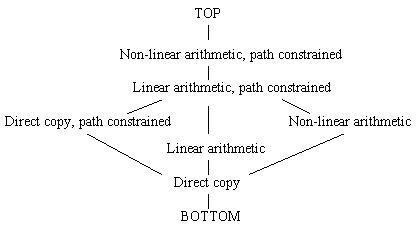
Now obviously real world constraint formulae will be much more complex than this, they could have hundreds of thousands of literals and conditions. A modern SAT/SMT solver will be able to handle such an input, but it could take a number of hours depending on the complexity. Because of this, it would be an advantage to be able to select those buffers that have the least complex constraint formulae (preferably one no more complex than a sequence of assignments, in which case a solver will not be needed). The basic classification scheme I’m using is represented by the following lattice:

Constraint complexity lattice

Formulae are associated with a single point in the lattice, with the more complex formulae towards the top and the less complex towards the bottom. We can classify based on the complexity of arithmetic in the formula, as well as whether it contains a path condition, like a jump conditioned on user input, or not.

When an object is created, representing the constraints on a given byte, it starts at ‘DIRECT COPY’ and its position in the lattice is updated as operations are performed on it. A byte can only move up in the lattice (i.e. there is only a join function, no meet), with the lattice position of a byte resulting from the interaction of two tainted bytes being the join of the those two source bytes. The join function is defined as the greatest upper bound of two inputs. We can then use this lattice to represent the constraint complexity of a single byte, or a sequence of bytes by taking the join of all bytes in the sequence. Currently, I have classified a path constrained direct copy and non-linear arithmetic as being of equivalent complexity but, with the arithmetic support in modern SMT solvers, it might turn out that a formula made up entirely of arithmetic operations, linear or non-linear, is easier to solve than one containing predicates that must be satisfied.

The advantage of the above scheme is that we now have a way to classify potential shellcode buffers by the amount of effort it will be to use them as such. By doing this we can potentially avoid calling a SAT/SMT solver altogether, and in cases where we must we can select the easier formulae to solve.

Difficulties in taint data propagation without an IR

I’m currently building a tool that propagates taint information through a program as it executes. Essentially this consists of marking the data read by certain syscalls (e.g. read and recv) as ‘tainted’, or user controllable, followed by tracking the flow of this data through the program. The ‘propagation’ occurs when tainted data is used as a source in an instruction, thus tainting the result. For example, if the data at address 0x100 is tainted and the instruction mov ebx, [0x100] is executed then ebx is now tainted.

To track all possible taint propagation is a fairly involved task. The mov instruction for instance has 4 potential configurations (memory to memory, register to memory etc.) and many instructions (arithmetic ones for instance), do more than simply copying memory. Considering that most binaries from the /bin directory on Linux have between 70-100 unique instructions, and many of these instructions have unique semantics in terms of how they spread the data from source operands into the destination operands, modelling these effects for each instruction would seem to be a fairly involved task.

It’s also a task I’m having to deal with at the moment due to my choice of dynamic binary analysis (DBI) framework. I am using Pin, a free but closed source DBI. One of Pin’s primary goals is speed and thus it can’t afford something like converting each basic block to an intermediary representation (IR) (like Valgrind does). This means we are left with convenience functions to access operators and operands and are required to perform a case by case analysis on each instruction. Luckily, the functions provided by Pin are quite well thought out. Let us consider how to process an instruction like mov dword ptr ds[esi+edx*4+0x2a0], ecx, where ecx is tainted. First of all, we must register a function with Pin to instrument each instruction. This is about as simple as you’d expect.

INS_AddInstrumentFunction(instruction, 0);

This function will then be passed each instruction and will have to decide the correct way to handle it.

VOID
instruction(INS ins, VOID *v)
{
    UINT32 cat = INS_Category(ins);

    switch (cat) {
        case XED_CATEGORY_DATAXFER:
            switch (INS_Opcode(ins)) {
                case XED_ICLASS_XCHG:
                    processXCHG(ins);
                    break;
                case XED_ICLASS_MOV:
                    processMov(ins);
                    break;
etc etc

As you can see, we can work at two levels of granularity. The instruction categories groups together operators with similar emantics e.g there are seperate categories for string operations like rep movsb, arithmetic operations, interrupts etc. The operators in certain categories all have the same taint semantics and we need not go any deeper, but others contain instructions that must be handled on a case by case basis. DATAXFER for instance, contains xchg, mov and bswap, among others, all of which require special attention.

In our example we will end up in the processMov function. The purpose of this function is basically to figure out which of the 4 mov cases we are considering. Pin provides the INS_IsMemoryRead/Write functions, and others, that allow us to figure this out. Quite usefully, it also provides a mechanism to determine the exact address written/read and the number of bytes written/read at run time. This saves us having to calculate the effective address ourselves. For our example we would use these functions to determine that we are writing to memory, from a register, and then use the following call to insert a run time hook to our taint propagation function:

INS_InsertCall(ins, IPOINT_BEFORE, AFUNPTR(simMov_RM),
    IARG_MEMORYWRITE_EA,
    IARG_MEMORYWRITE_SIZE,
    IARG_UINT32, INS_RegR(ins, INS_MaxNumRRegs(ins)-1),
    IARG_END);

You can see here the use of IARG_MEMORYWRITE_EA to get the effective address of the write and the use of INS_RegR to get the last read register (ecx in this case). At runtime this will result in the simMov_RM (simulate mov register to memory) function being called with the specified arguments. It is this function that will finally do the taint propagation.

As you can see there are many cases that must be considered, even for a seemingly trivial operator like mov. Even the above explanation doesn’t deal with the case where a register used in calculating an effective address is itself tainted and requires more code to process correctly. A potential solution, suggested by Silvio might be to do a case split in some cases and then have a default case for instructions not explicitly handled. A solution like this, that over-approximates the tainted data, could lead to extensive false positives though and is not really suitable for the kind of work I’m doing. This leaves one other obvious option for a ‘default case’, and that is to untaint all destination operands in instructions I do not handle. This will lead to an under-approximation of the amount of tainted data, until I encode the semantics of all instructions, but will eliminate false positives and allow me to work on other parts of the algorithm once I have encoded the most common instructions.